We experience a sense that there are possibilities that are better than what we are
and have been.[i]
When I was a child, after supper my father liked to open his World Atlas, and, on the kitchen table of our small house, my brothers and I would pinpoint a country we wanted to look up and find out about. In those days, since geography was my favorite subject, I was very content with these family explorations.
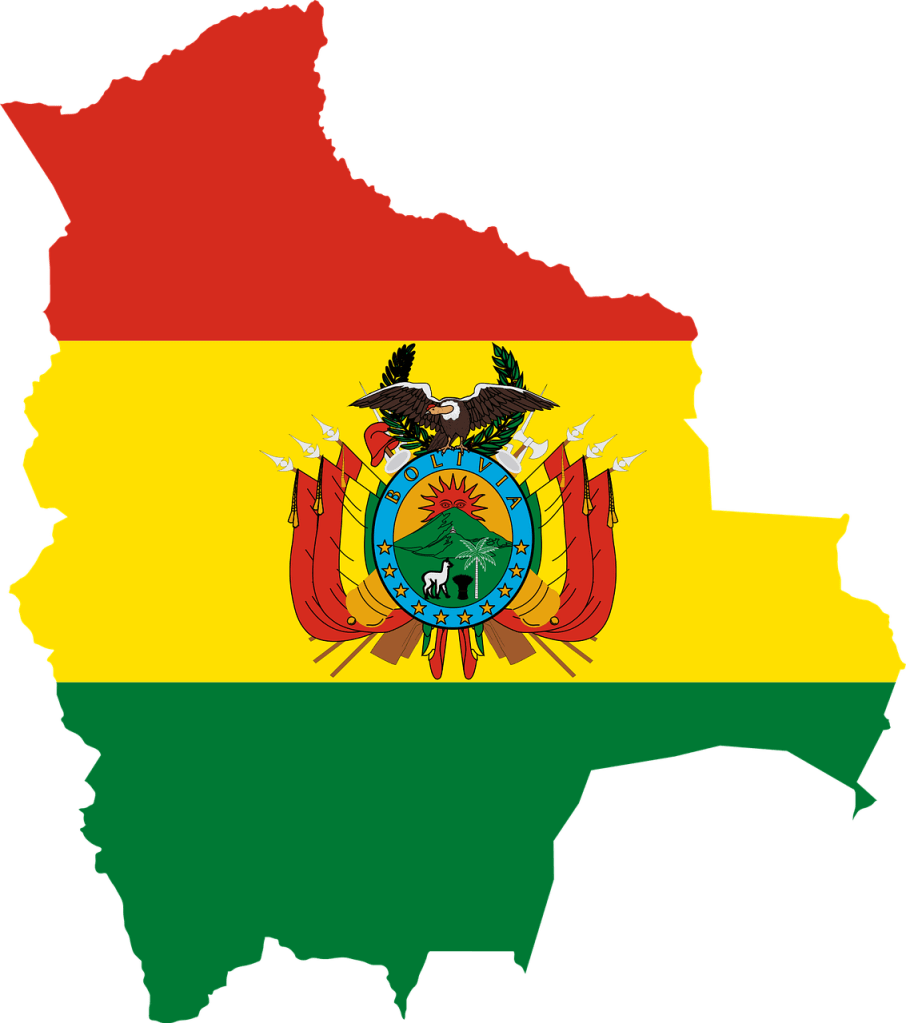
For some reason, among the many countries we looked up, I never forgot certain details about the county of Bolivia. I remembered that Lake Titicaca was the World’s highest navigable lake. I remembered that Aymara was the language of the people who lived on the shores of the lake, and how the women dressed and carried their babies on their backs.
Later, I learned of the steep trails of the Andes Mountains and the remote villages of Quechua People who lived there with their flocks of sheep and llamas. I learned of the tropical lowlands of the Beni stretching into Brazil with their settlements accessible only by way of tributaries of the mighty Amazon River.
These days, influenced by the life and work of the quantum physicist David Bohm, I am looking at events and patterns that seem to have been present in my life from childhood and which are still today unfolding in their meaning. Whereas previously I shied away from dwelling on the past, now I am seeing that the past is present and still happening. Better said, it appears that meaning from past events is not only available and retrievable as memories but happening now. Perhaps I have always known this but never consciously considered it.
The country of Bolivia and my experiences related to it are uppermost on my mind. In this post I will explore one of these experiences in view of what I am learning as I study the ideas of Bohm and the developing Holomovement, which he originally named.
As it happened, as a young adult I maintained my interest in lands and people beyond my own. This interest, I found, could not be satisfied by tourism. It was, then, without hesitation that I responded to the opportunity to work in Bolivia, where I ultimately remained for fifteen years. These were incredible years with the richest of cultural experiences among the Aymara and Quechua Peoples as well as briefly with the people of the Beni, close to Brazil.
I spoke Spanish well enough, however, while Spanish was the language of the State, it was not the language of the ordinary people. The people used multiple languages, which had no roots in Latin or European based languages. Ordinarily these languages were very challenging for foreigners to learn. This was certainly true for me. Beyond the most elementary of conversations required continuous study and practice.
Academically speaking, I knew that language carries culture. Knowing this was good motivation for persevering in the hard work of language learning. Reflecting back though, I did not know deeply what that meant. I considered it important to both know and respect how the people thought. What I missed was personally knowing as they know.
Most of my years were spent among the Indigenous Quechua speaking people living deep in the Andes.
Aside from the challenge of language and culture learning, it took me a long time to recognize and undo an assumption that was as natural to me as breathing: I thought that as Americans we had reached a civilizational pinnacle. On top of my natural interest in cultures, I was motivated by wanting to share developmental ideas and means toward a better life as perceived within the Western Worldview. I shudder now to think of how limited I was. I did not even know then that there were other worldviews or valid ways of grasping the nature of the Cosmos and one’s role and place in it. Much less, did I then understand how much I was influenced by materialism.
I certainly did not then frame my overarching perceptions as flowing from a materialistic society. It is aways complex to look at this, especially because this same society obviously has provided benefits that are good for humanity, particularly health and medical benefits and the elimination of terrible diseases. The problem, as I see it, stems from limited philosophical understanding.
These were the same years that found Bohm standing back from scientific orthodoxy, observing its deadening effect on society, underpinning the loss of meaning and expansiveness, limiting knowing how the world works to what could be observed and measured. Bohm did not vilify scientific processes, rather he grasped more than what could be measured and determined by them. He found himself plunging into and systematically studying spiritual and religious experiences and beliefs as passed down through ancient traditions, including the traditions of Indigenous People. He paid attention to what he felt. He sensed that there is a unified field beneath all that emerges and is consciously known. He called it the Implicate Order. This is what brings forth the emerging evolutionary world and all potential while sustaining the physical and cosmological order that all generations of people trust as the background of their lives.
Indeed, Bohm took his brilliant mind and honest character to every field he explored.
He was captivated by language and the possibility that all ways of communicating and perceiving are available to newly forming humans still within the womb. He saw that the structure of spoken language influences perceptions.
In view of this, during the past summer I attended by Zoom a riveting conference entitled Beyond Bohm: an order between and beyond, by David Schrum, PhD, sponsored by the Pari Center, in Italy. One of my learnings from this conference is the importance and significance of being attuned to what is transpiring. Related to this, I had an experience among the Quechuas that changed me profoundly. I think this happened because I tried to understand their culture and speak their language. As often happened, I was invited to a distant village to participate in its annual fiesta. On the eve of the fiesta, I set out in the early morning hiking part way and mounted on horseback part way, arriving in the village around three in the afternoon. The people who belonged to the village were also arriving from their plots of land which were scattered throughout the hillsides. The atmosphere was joyful and celebratory. We gathered together and I was invited to speak. Then they served me a big meal and some people came to talk and make arrangements for one thing or another, including for medical help. By then it was dark, and the people showed me where I would spend the night. I knew that they would be up until dawn lost in their traditional preparations for the next day.
Earlier, they were very proud to show me a simple and quite precious chapel they had built. Whereas I had never before intruded beyond what the people invited me to participate in, I felt compelled that evening to wend my way back to the chapel, which I could see was bright with light from candles and small oil lamps. I went inside and sat down on the dirt floor just inside the door. There were many people there, all engaged with the holy in their own way. I was taken by one woman in particular, so concentrated was her prayer. I felt connected to her.
While I’m sure there was present some influence from the European missionaries of years long past, I was transported into a mode of spiritual experience that seemed to predate foreign influences. I was consumed! What has stayed with me all these years since then is the undeniable memory of knowing the Sacred in and through the way of the people. This was not a temporary alteration after which I returned to my usual way of being. Interiorly I was changed and set on a path that I could not have known otherwise.
This was the most expansive experience of my life. It immediately opened me to seeing the limitlessness of the Sacred beyond all prescriptions and prepared the way for what I have come to identify in later years as the interconnected whole described by Bohm. This did not come to me so much through the Quechua language as through the attunement that came to me through what the language opened up, even if not entirely grasped.
Since then, I see differently in terms of worldview, and I know differently. Perhaps most importantly, I cannot separate these bedrock life experiences from a perception of purpose or call running through my life. This has come to include offering some form of healing as service to people or to the Earth itself, as I’ll explore in another post.
Bolivia is always present as a thread running back and forth in my life, always tending toward potential yet unrealized.
[i] The Holomovement: Embracing Our Collective Purpose to Unite Humanity, Light on Light Press, 2023, Edited by Emanuel Kuntzelman & Jill Robinson, p. 54.

 Evolutionary Consciouness