Holomovement V

An emergent cosmology of evolutionary consciousness, on increasingly compelling evidence, is finding that everything in our Universe is in dynamic and collaborative relationships with everything else. (1)

Part One

A long time ago, when I was in my early twenties, every week I visited a young woman who had contracted a strain of polio that left her almost entirely paralyzed, unable to do anything for herself and very weak. My heart ached for her as I considered her great loss and the bleakness of her future. At the time, while I understood that we live our lives in profound mystery and that one’s meaning, depth and value are not circumscribed by health and well-being, I wanted to be able to say why this is true. I longed  to discover a satisfactory explanation showing that at the core of existence we are all the same – not limited by illness or any other circumstance. This quest has persisted over the years intensifying as my knowledge and experience of random suffering, injustice and inequity has grown. I am always seeking, wanting  to understand more thoroughly what can be known about existence in a universal sense. At the same time, I have known moments when I feel illuminated, when my soul is in resonance with an aspect of truth not previously known. Sometimes this happens through studying the work of others and sometimes it happens through my own experience.

I will share here some of these moments and how they interface with my wonderings, particularly in relationship both to life’s wounds and life’s possibilities for regeneration and healing.

For a number of years I followed the work of Terry Patten, a philosopher, through his podcast entitled Beyond Awakening. I found his ease with being present to the moment that was unfolding very attractive and worthy of exploration and practice. I discovered that past happenings continue to reveal new meaning; in a sense, I think, past events are still unfolding.

Through Terry’s interviews I met many outstanding thinkers whose work I have continued to follow. Then, when Terry’s book, A New Republic of the Heart, was published I was enchanted. I was particularly drawn to references to wholeness. Terry did not define wholeness in exact terms, referring to “the mysterious wholeness that is already our condition” (p.141)  realizing, I think, that there are perceptions of the nature of existence that do not lend themselves to neat definitions. The way Terry spoke of wholeness seemed reverent and of the moment. Going back over his work, I see now that as a philosopher, he was touching into quantum physics, acknowledging an interior realm beyond our capacity for exact observation and measurement.

Terry led me in two directions, back to an earlier interest in the work of the quantum physicist David Bohm, and his understanding of the implicate order as the wholeness from which everything flows, and forward to the related work of the contemporary cosmologist Jude Currivan and her grasp of “A unitive narrative of wholeness and innate belonging.”

Bohm’s work and style had great appeal to me. I was drawn by the fact that as a scientist of great intellect, he enthusiastically engaged conversation with philosophers, spiritual leaders and Indigenous authorities; open to being illuminated by their insights. This strikes me as significant because it honors the inner realm of human knowing across time as it coincides with contemporary scientific thinking.

It is Bohm who first imagined the Holomovement, in which people and groups of people everywhere, from the strength of their common origin in wholeness, would support each other, moving into an era of conscious participation in shaping humanity’s future, for the health and well-being of the whole Earth.  

Likewise with Jude Currivan. Her work is in sync with Bohm’s but more developed because of the cosmological breakthroughs of recent decades. Also, Jude’s character is warm and engaging, easily drawing others into a sense of wonder at our common background, at our belonging together as in a family. Like Bohm, she has traveled and continues to travel widely sharing her knowledge and insights enthusiastically, garnering in return the wisdom and affection of people from many countries, cultures and social conditions.

Jude’s central message is that all that has emerged and will emerge is bound in wholeness initiated in one breath and sustained in one love through countless manifestations. She describes beautifully aspects of this that I found most captivating. What most drew my attention was her reference to HGT, or horizontal gene transfers. Succinctly said, scientists are finding that evolutionary opportunities can be accessed outside of the vertical inheritance lineage of DNA, increasing the opportunity to survive and thrive (although not known yet in humans). With Jude, I see the possibilities for someday being able to apply HGT to people who have debilitating illnesses or disabilities, giving them a chance for a fuller life.

The sense of wholeness as Jude sees it, means belonging and binds all of us together. It is the ultimate structure of the Universe and the reason why we are at our fullest sense of being through love and compassion, stretching ultimately towards well-being for all. This generative understanding is profoundly hopeful.

Part Two

Musing over the above brought to mind the memory of several experiences I had years ago in which the innate sense of belonging was touchingly manifest. This happened when newborn abandoned babies I knew seemed to choose or know their true parents. I will relate here the stories of two babies that lost their biological parents but found their true parents. These experiences complement the importance of a child’s environment while highlighting a deeper element, an infant’s recognition of where it belongs, the place where mutual love will flourish.

I was working in Cochabamba, Bolivia, at the state-run hospital when I received a telephone call from a couple in Boston who had done volunteer work in Bolivia. This was before the advent of mobile phones and traditional land line phones were scarce, so the fact that the couple easily reached me was worth noting. The couple had married late and did not expect to have children. However, the wife became pregnant but miscarried. This painful experience opened within her a profound desire to nurture a baby. Particularly, the couple wanted to know if by any chance there were an abandoned baby in Cochabamba that they could adopt. I asked them to give me a bit of time to look into this and get legal advice. I knew that by law adoption by foreigners was not permitted. They said they would call me again the next day. Unbelievably, by the next day I had been able to get a court order allowing the couple to adopt a child in Bolivia. They were ecstatic and for the next few weeks called me regularly always hoping that “their” baby had been found. Then, a beautiful, healthy baby girl was born at the hospital but immediately abandoned. The birth mother could not be found and all the personal information she had supplied turned out to be false. She had simply walked out of the hospital immediately after safely delivering the baby. The couple in Boston was filled with hope that this was their baby. However, in such cases the law required a waiting period of three months before allowing adoption procedures to begin. In compliance with this policy, the baby remained in the hospital nursery. The couple remained in Boston keeping vigil from there.

Exactly as the waiting period ended, the couple flew to Bolivia. Previously, they had arranged to rent a house to stay in while putting everything in order for the adoption process to be advanced and finalized.

The day after their arrival, I took them to the hospital to see the baby. While generally I am not a camera person, I thought to grab the camera that belonged to my office just as I left to pick up the couple. I hoped to get a shot of the new mother as she saw the baby for the first time. By the time we reached the waiting room of the hospital nursery, the couple’s anxious, hopeful anticipation was utterly palpable. Fortunately, after just a few minutes, a nurse arrived with the baby and placed her in her new  mother’s arms. At that precise instant, the baby reached up and touched her new mother’s face. I have never forgotten that moment. And, fortunately, I had the presence of mind to snap a photo that stunningly captured it.

In the years that followed the love and affection between mother and child only deepened. Needless to say, the baby flourished and ultimately loved generously as she had been loved. The adopting father who was never lost for words, on that day when he first saw his new daughter, became speechless, seemingly lost in the grace that had found him. He adored her from then on and never stopped talking about her.

Something similar took place with a newborn baby boy. This time a medical student approached me at the hospital and asked if he could give me his three-day old baby boy. The student was not married and the birthing mother, a young Indigenous girl, was despondent and unable to nurture the baby. She was a long way from home and could not return to her family with a baby. Neither could the father seek help from his family. Worried that the baby might not survive, I told him to meet me at the bus station the next day, with the baby and the mother.

Just prior to this, a social worker assigned to a nearby village advised me of a childless couple that wanted desperately to adopt a baby. I called her immediately and told her of the situation with the medical student. Not knowing how things would work out but hopeful, she agreed to meet me the next day at the bus station. Meanwhile, she would take care of the papers for the baby’s parents to sign in handing over the baby.

The next day the student, the mother and the baby were waiting for us at the bus station, and all went as planned. I felt great sadness for the young mother, who was indeed despondent. After receiving the baby from her, the social worker and I watched as the student helped her board a bus beginning the long journey back to her family. He then returned to school. I did not see him again.

Then, while I drove to the village of the couple that had expressed a desire to adopt, the social worker sat next to me in the front seat holding the baby. When we turned into the village from the highway, the social worker suggested that I pull over and park a ways from the house of the couple. Since they did not have a phone, she wanted to visit them first and tell them about the baby to be sure that they truly wanted a baby immediately. After I parked, she handed the baby to me; then she walked in front of the car toward the house. The baby nestled against my chest facing the rear, sound asleep.  After a few moments the baby’s little heart made a sudden leap and he awakened. When this happened, I looked up and saw the baby’s new father running pell-mell down the middle of the road toward the car. When he got to the car, he reached in through the open window and lifted out the baby saying my son, my son, kissing him and dancing jubilantly.

When the adopting mother arrived her happiness too was boundless, doubled, I think, by the joy of her husband and the undeniable feeling that the baby had recognized them as his parents. Immediately, they went to the municipal offices and registered the baby as their own, as he truly was. Needless to say, not only did the baby survive its hopeless beginning but he came to be the joy of all his extended family, unbelievably smart and happy.

Part Three

While I lived in Bolivia I ordinarily attributed the differences in ways of perceiving to differences in culture and worldview that correspond to a less evolved developmental stage. This may be true in some respects, however over time, I have come to see more broadly: I realize that I have been shaped culturally and intellectually by unquestioned assumptions of the Modern Age. Having been exposed to other ways of thinking and knowing, I now think that the Modern Age, while making enormous contributions to the well-being and ease of countless people, in its very progress and materialistic cast has lost its sensitivity to ways of knowing arising from a deeper, unmeasurable realm, the realm of wholeness. Perhaps the unitive Cosmology that Jude presents will help the human spirit reconnect with the fullness of its possibilities.

Conclusion

I feel grateful that my experiences living in parts of the world beyond the West confirm what I understand as I pour over Jude’s work: Love and belonging are the definitive characteristics of the Universe, ours to know and experience through endless means and manifestations.  

I end with a few questions:

  1. Is the Modern Age now evolving toward a more expansive and inclusive philosophical view of life?

2.   Will the contemporary decline in traditional main-stream religious forms now give rise to           spiritual articulations that recognize wholeness as our common ground?                  

  3.   Can we make conscious human decisions to be a healing presence to each other?                       

4.   Will the United Nations’ vision of One Earth Community take hold?                                     

5.   Are these questions a manifestation of the Holomovement already present among us?

Continue reading “Holomovement V”
Holomovement IV

As we wake up to the radical reality of a unitive narrative and our emergent opportunity as a Holomovement, we also will discover as a species, perhaps for the first time, who we really and truly are and who we can evolve to become. [i]

For a long time I was taken up with exploring emerging ideas stemming from the New Cosmology, about Planet Earth in its galactic origins, biological emergence and conscious awakening. It seemed important to know the facts, at least to the extent that I could as a non-science major and philosophically leaning person. I became enchanted by the work and creative style of physicist Brian Swimme and his poetic mentor, geologist Thomas Berry whose insights, in turn, built upon the expansive work of paleontologist and theologian Pierre Teilhard de Chardin, whom I had read years earlier (with practically no understanding). I wondered what would next attract me.

It was with pleasure, therefore, that I discovered the work of Jude Currivan by way of the State of Emergence podcasts. Jude explores the concepts of cosmic hologram and consciousness. I particularly liked her positive and deeply respectful sharing regarding her learning experiences among Indigenous People from various parts of the world. I was happy to see her chapter entitled, A Unitive Narrative: Cosmology Underpinning the Holomovement, in the Holomovement book and have read it several times. As a result, I am seeing parallels between what is happening on a universal scale regarding consciousness unfolding and what I see as an unfolding narrative within myself.

Previously, I wrote about my time living among the Quechua People of Bolivia, South America. I will pick up my narrative here.

My work among the Quechua People was facilitated by a man who lived near me in the tiny town of Morochata, in the Province of Cochabamba. He understood the culture of the people and knew how to communicate with clarity and kindness. His name was Don Pasqual Villarroel. He came from the capitol city of La Paz[ii] and had attended elementary school through the fifth grade. He was universally admired, both because he came from a far-away important place and because he had been to school. He was my liaison with all the leaders and people of the villages scattered throughout the mountains.[iii]

One of my projects was working with the Department of Health to improve sanitation in rural areas by building outhouses, at least one for each village. To this end, I had a 12-battery operated filmstrip projector and a Mexican animated filmstrip series called Carlos Campesino. I lugged this equipment with me everywhere I went. I showed the filmstrips at night when it was dark. The people absolutely loved them. To my delight,  the favorite of all was ‘How to Build an Outhouse.’ I always had to show it twice. The people were highly entertained and laughed and laughed. It took me a while to realize that the people could not imagine accumulating so much waste in one place! Nevertheless, during that time, outhouses aside, technology from the modern world became more and more valued as did the grasp that illness could be prevented and suffering relieved through modern sanitary practices and medical attention. Don Pasqual played an outsize role here in explaining things in a way that folks understood and appreciated. As well, he always showed respect for local shamans and healers. Steadily, more and more people wanted to know how they could obtain medicine and receive help from medical doctors for situations that were beyond the skill and knowledge of local healers.

However, while I could help the people access the materials needed to build an outhouse, what could not be accessed were services of medical personnel for preventing and treating illnesses. Personnel for doing this kind of work in remote and difficult to reach places was not available and, furthermore, there was simply no budget for paying salaries for professionals even if such professionals were available.

At the time, I often wondered if it were correct to introduce elements of the modern world to people who were living in a cultural milieu that was hundreds of years old, under an unstable and bankrupt government. Now though, influenced by Jude’s work, I think that consciousness steadily expands in an evolutionary trajectory and that we need to go forward hand-in-hand sharing with each other in a way that is of benefit to all, regardless of our differing developmental stages, simply doing the best we can.

Back then with less clarity, I went to the City of Cochabamba, and consulted a medical doctor and cardiac specialist whom I knew. My basic concern was finding some way to provide medical services for the people living in practically inaccessible mountainous areas. The doctor I consulted with offered to meet with a number of young medical doctors who might be willing to brave the mountainous terrain and volunteer their services on a rotating basis.

Happily, thanks to the doctor’s quick work, this project got off the ground almost immediately permitting us to set up regular medical attention free of charge for all who needed and wanted it. It was a pleasure getting to know the bright and very skilled young physicians who offered their services. They were friends with each other and very dedicated to their profession. They came on the weekends and, due to the organizing work of Don Pasqual, the local people took advantage of their services. I was happy to become friends with these doctors and greatly admired them. I particularly enjoyed their humor and always looked forward to their arrival.

In the city there was a government owned and run hospital for indigent citizens. I had taken very ill patients there in the past, but the conditions were deplorable, and I had decided not to go there again. In my conversations with the doctors, I learned that this hospital actually had in its storage unit, state of the art medical equipment, which it could not afford to install due to a lack of funds and a totally inadequate and very deteriorated infrastructure including no running water and the lack of regular electricity. This situation seemed hopeless as the government was bankrupt without a path for recovery in the foreseeable future.

As time passed, the doctors began talking about forming a group that would work to raise funds privately in order to upgrade the hospital and install the aforementioned equipment, which was still in its original maritime shipping crates. I thought this was an excellent idea for them to pursue. However, I was surprised to be asked to join them at the hospital to look over the equipment as a first step toward effecting this idea. I did not want to do this because of my very negative feelings about the hospital but I felt I could not refuse because of all the help the doctors had provided me, and because of the bond that had been established among us. I therefore made the trip to Cochabamba, although without enthusiasm. However, when we entered the equipment storage space, my interest was sparked immediately because the first thing I saw was the equipment for an intensive care unit. At that time, there was no intensive care service available for anyone in Cochabamba, much less for poor Indigenous People. And, I actually knew something about installing intensive care units.

Many years prior to that time, when I was in college, I took a part-time job at a hospital in Boston that was creating its first intensive care unit, a new concept at the time. I was hired as assistant to the secretary of the hospital administrator and assigned to do the secretarial work associated with the new unit, which was in its planning stage. These were pre-internet times, so to prepare myself I collected every available piece of printed material on the subject of intensive care units and studied it intensely. I participated in every aspect of the unit as it took shape, even working overtime to get everything right. Because I was young and totally inexperienced, I always carried a clipboard and took copious notes. I think the clipboard actually functioned as a protective shield to my psyche given that I was surrounded by highly educated medical professionals.[iv]

This youthful experience slipped away from my active memory for many years, as I went on to other jobs and other challenges. Now, two decades later, Bolivia had the possibility of creating its first intensive care unit in Cochabamba, then the second largest city in the country. I found myself irresistibly attracted to this project.

In very little time, with the authorization of the government, we established a foundation to benefit the hospital and, once again, clipboard in hand, I proceeded to take an inventory of all the new equipment available before anything was removed from the shipping crates. I then inventoried all the old equipment currently in use. Meanwhile, we raised money through every imaginable means. Once we had a start-up fund and fair money raising prospects for the future, we took out a bank loan using the ancient car of one of the doctors as collateral and plunged into the work of remodeling the rickety hospital. We began with creating the intensive care unit (ICU), which drew immense interest and support from the public and, very importantly, from the governing board of the medical school of the University of Bolivia. This led directly to creating a diagnostic support center and high-risk operating room, and much, much more. We found that, generally, hospital staff were eager to learn new techniques and brush up on forgotten standard practices and methodologies. The day we inaugurated the new ICU was wonderful and intensely uplifting. Highly motivated, we labored on, creating and implementing one new unit after another.

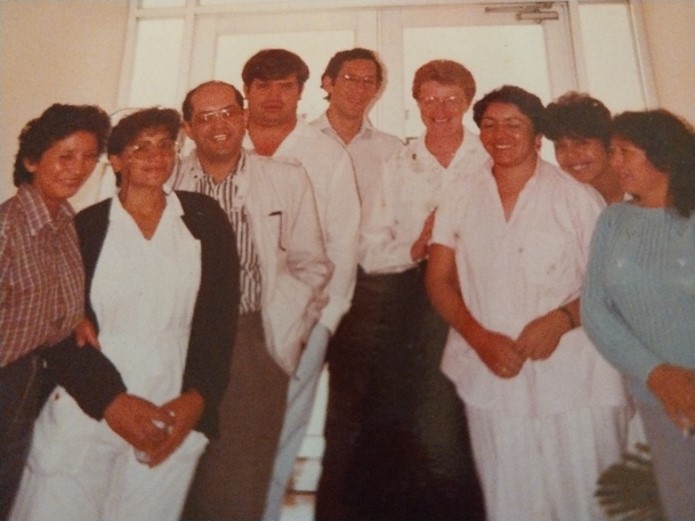
Our staff on the occasion of the ICU launch

Ultimately, the Japan International Cooperation Agency (JICA) financed building a new modern hospital and one of my young friends, Oscar Ferrufino, MD, became its first medical director (fourth from the left in the photo).

Finally, what began among the Quechua People in remote communities in the Andes spread in ever widening circles, meeting the needs of a much larger population. We began with instructions on how to build an outhouse and finished with building a hospital. Indeed, one of the eight points describing the Holomovement states that ours is a self-healing cosmos, which, in its widespread awakening of virtuous social projects, is establishing what may be described as analogous to a planetary immune response.  Reflecting back, I think Jude Currivan would refer to this experience as a widening embrace of healing consciousness, which seems doubly applicable in this case because the social project had to do with actual healing.

All these memories are evoked because of my expanding understanding of the evolution of consciousness and the Holomovement’s irrevocable insistence on our coming together as individuals, as groups, and as society, relentlessly drawn toward bringing forth a unified global civilization of well-being for the whole Earth and for all people.

It is now midnight, and, as I complete this work and this day, letting my happy memories and long narrative rest, a sweet night prayer arises within me – Shield my joy!

There is still more to examine in Jude’s Holomovement chapter, which I will do in my next post.


[i] The Holomovement: Embracing Our Collective Purpose to Unite Humanity, Light on Light Press, 2023, Edited by Emanuel Kuntzelman & Jill Robinson, Chapter 2, A Unitive Narrative, Jude Currivan, PhD, p. 73.

[ii] Sucre is the judicial capitol while La Paz is the Seat of Government.

[iii] The people thought that I too came from LaPaz and could not imagine the world beyond this distant and quite vast place.

[iv] Later, I learned that the rest of the staff thought that I was an administrative supervisor because of the clipboard. I have been partial to clipboards and the symbolism of the shield ever since. This would become more meaningful in a later experience, in a different country under radically different circumstances. 

Holomovement III

We experience a sense that there are possibilities that are better than what we are

and have been.[i]

When I was a child, after supper my father liked to open his World Atlas, and, on the kitchen table of our small house, my brothers and I would pinpoint a country we wanted to look up and find out about. In those days, since geography was my favorite subject, I was very content with these family explorations.

For some reason, among the many countries we looked up, I never forgot certain details about the county of Bolivia. I remembered that Lake Titicaca was the World’s highest navigable lake. I remembered that Aymara was the language of the people who lived on the shores of the lake, and how the women dressed and carried their babies on their backs.

Later, I learned of the steep trails of the Andes Mountains and the remote villages of Quechua People who lived there with their flocks of sheep and llamas. I learned of the tropical lowlands of the Beni stretching into Brazil with their settlements accessible only by way of tributaries of the mighty Amazon River.

These days, influenced by the life and work of the quantum physicist David Bohm, I am looking at events and patterns that seem to have been present in my life from childhood and which are still today unfolding in their meaning. Whereas previously I shied away from dwelling on the past, now I am seeing that the past is present and still happening. Better said, it appears that meaning from past events is not only available and retrievable as memories but happening now. Perhaps I have always known this but never consciously considered it.

The country of Bolivia and my experiences related to it are uppermost on my mind. In this post I will explore one of these experiences in view of what I am learning as I study the ideas of Bohm and the developing Holomovement, which he originally named.

As it happened, as a young adult I maintained my interest in lands and people beyond my own. This interest, I found, could not be  satisfied by tourism. It was, then, without hesitation that I responded to the opportunity to work in Bolivia, where I ultimately remained for fifteen years. These were incredible years with the richest of cultural experiences among the Aymara and Quechua Peoples as well as briefly with the people of the Beni, close to Brazil.

I spoke Spanish well enough, however, while Spanish was the language of the State, it was not the language of the ordinary people. The people used multiple languages, which had no roots in Latin or European based languages. Ordinarily these languages were very challenging for foreigners to learn. This was certainly true for me. Beyond the most elementary of conversations required continuous study and practice.

Academically speaking, I knew that language carries culture. Knowing this was good motivation for persevering in the hard work of language learning. Reflecting back though, I did not know deeply what that meant. I considered it important to both know and respect how the people thought. What I missed was personally knowing as they know.

Most of my years were spent among the Indigenous Quechua speaking people living deep in the Andes.

Aside from the challenge of language and culture learning, it took me a long time to recognize and undo an assumption that was as natural to me as breathing: I thought that as Americans we had reached a civilizational pinnacle. On top of my natural interest in cultures, I was motivated by wanting to share developmental ideas and means toward a better life as perceived within the Western Worldview. I shudder now to think of how limited I was. I did not even know then that there were other worldviews or valid ways of grasping the nature of the Cosmos and one’s role and place in it. Much less, did I then understand how much I was influenced by materialism.

I certainly did not then frame my overarching perceptions as flowing from a materialistic society. It is aways complex to look at this, especially because this same society obviously has provided benefits that are good for humanity, particularly health and medical benefits and the elimination of terrible diseases. The problem, as I see it, stems from limited philosophical understanding.

These were the same years that found Bohm standing back from scientific orthodoxy, observing its deadening effect on society, underpinning the loss of meaning and expansiveness, limiting knowing how the world works to what could be observed and measured. Bohm did not vilify scientific processes, rather he grasped more than what could be measured and determined by them. He found himself plunging into and systematically studying spiritual and religious experiences and beliefs as passed down through ancient traditions, including the traditions of Indigenous People. He paid attention to what he felt. He sensed that there is a unified field beneath all that emerges and is consciously known. He called it the Implicate Order. This is what brings forth the emerging evolutionary world and all potential while sustaining the physical and cosmological order that all generations of people trust as the background of their lives.

Indeed, Bohm took his brilliant mind and honest character to every field he explored.

He was captivated by language and the possibility that all ways of communicating and perceiving are available to newly forming humans still within the womb. He saw that the structure of spoken language influences perceptions.

In view of this, during the past summer I attended by Zoom a riveting conference entitled Beyond Bohm: an order between and beyond, by David Schrum, PhD, sponsored by the Pari Center, in Italy. One of my learnings from this conference is the importance and significance of being attuned to what is transpiring. Related to this, I had an experience among the Quechuas that changed me profoundly. I think this happened because I tried to understand their culture and speak their language. As often happened, I was invited to a distant village to participate in its annual fiesta. On the eve of the fiesta, I set out in the early morning hiking part way and mounted on horseback part way, arriving in the village around three in the afternoon. The people who  belonged to the village were also arriving from their plots of land which were scattered throughout the hillsides. The atmosphere was joyful and celebratory. We gathered together and I was invited to speak. Then they served me a big meal and some people came to talk and make arrangements for one thing or another, including for medical help. By then it was dark, and the people showed me where I would spend the night. I knew that they would be up until dawn lost in their traditional preparations for the next day.

Earlier, they were very proud to show me a simple and quite precious chapel they had built. Whereas I had never before intruded beyond what the people invited me to participate in, I felt compelled that evening to wend my way back to the chapel, which I could see was bright with light from candles and small oil lamps. I went inside and sat down on the dirt floor just inside the door. There were many people there, all engaged with the holy in their own way. I was taken by one woman in particular, so concentrated was her prayer. I felt connected to her.

While I’m sure there was present some influence from the European missionaries of years long past, I was transported into a mode of spiritual experience that seemed to predate foreign influences. I was consumed! What has stayed with me all these years since then is the undeniable memory of knowing the Sacred in and through the way of the people. This was not a temporary alteration after which I returned to my usual way of being. Interiorly I was changed and set on a path that I could not have known otherwise.

This was the most expansive experience of my life. It immediately opened me to seeing the limitlessness of the Sacred beyond all prescriptions and prepared the way for what I have come to identify in later years as the interconnected whole described by Bohm. This did not come to me so much through the Quechua language as through the attunement that came to me through what the language opened up, even if not entirely grasped.

Since then, I see differently in terms of worldview, and I know differently.  Perhaps most importantly, I cannot separate these bedrock life experiences from a perception of purpose or call running through my life. This has come to include offering some form of healing as service to people or to the Earth itself, as I’ll explore in another post.

Bolivia is always present as a thread running back and forth in my life, always tending toward potential yet unrealized.


[i] The Holomovement: Embracing Our Collective Purpose to Unite Humanity, Light on Light Press, 2023, Edited by Emanuel Kuntzelman & Jill Robinson, p. 54.

The Holomovement II

For a number of years in the month of January just after the New Year, I traveled to the small resort town of Hua Hin, near Bangkok, for a gathering of folks from the organization that I was associated with. We were nearly 100 people from different countries working throughout South Asia – all happy for some down time and looking forward to renewal on different levels.

It was there in Hua Hin that I met John Beeching, who had worked in various countries in Asia and at that time was working in Thailand. All I knew of him was that he was a warm and pleasant person, a Canadian by birth and a trained nurse, and that he taught English to a group of refugee Buddhist monks in turn for their instructing him in their spiritual traditions. I knew he faithfully practiced Zen style meditation.    

Some years later, I attended a meeting about social justice in Guatemala City, Guatemala; The only thing I clearly remember about the meeting is the totally unexpected arrival of John. I immediately felt overjoyed to see him and we fell into easy conversation stemming from our common background in Asia. What I most vividly recall is a conversation about prayer and the contemplative way. From deep within he shared about his experience with the monks, where the experience had led him and how important to his life the pursuit of spirituality had become. He was living an uninterrupted encounter with the Sacred.  When asked how he sustained this, he said simply, “I am drawn”.

During the summer of 2022, John died. As soon as I heard the news of his passing I could think only of his words “I am drawn.” I felt as if John had bequeathed to me these words as a mantra and as an aspiration. It was later in reading the testimonies to his life that I came to know him as an extremely talented and gifted person, present to everyone as they needed him to be. Particularly, I learned that John was influenced throughout his adult life by the life and writings of the Trappist Monk Thomas Merton, who also sought the Holy beyond his own tradition, and whose many experiences, generously and eloquently shared, helped to shape the contemporary mystic spiritual path.

John’s death occurred at a time when I was experiencing shifts within and around myself. Without exception, these shifts seemed aligned with a pull toward giving priority to prayer. This was not a new tug but there was a new dimension to it. Beyond a doubt, I was being drawn beyond what I had previously known and practiced. Daily I felt John’s presence.

Around this time, I looked at the film Infinite Potential: the Life and Ideas of David Bohm [ii]. This is a beautiful film that I have watched several times now. Each viewing reveals something new that I had previously missed. It shows Bohm, a physicist, as open and attentive to what is arising within him and around him.

As a scientist, Bohm authentically explored his experiences and theories with other scientists. He firmly believed that there is much more to be learned about the nature of the Universe and life, and that most probably humanity will never thoroughly understand or be able to fully describe how the Universe functions. As Bohm points out, we are part of the Cosmos and cannot step back from it to adequately describe it. Furthermore, ours is an evolutionary Universe. Therefore, to be open to new ideas and ways of perceiving is fundamental.

He was never dismissive of spiritual experience. Rather, he tried to understand it better sensing its relation to the fundamental nature of reality.

He sought out persons of faith within the Eastern spiritual traditions as well as Indigenous leaders and others attuned to the mystery that seemed to lie just below ordinary experiences. It seemed to Bohm that the spiritual grasp of these people was essentially the same: The world around us is arising from and falling back into an unseen order that is in constant flow and is completely interconnected and whole.

This perception aligned with Bohm’s. He called it the Holomovement.

As a physicist, Bohm, who died in 1992, was ahead of his time. Now, however, physicists have been able to affirm Bohm’s insights through rigorous experimentation supported by complex mathematics. The time of the Holomovement has now come. In the weeks ahead we will continue to explore what this means for the world of today, scientifically, spiritually and socially.

Meanwhile, I feel gratitude to David Bohm, for his great intelligence, humanity and fearless pursuit of truth. As well as for John, who was open and available to anyone who needed his help and who had a working conviction of wholeness, not because he dabbled in religious and spiritual experience but because he gave himself over to the practice of encounter with the Holy and its social consequences.


[i] A Holomovement white paper, The Flow Between Source and Self that Enhances the Whole. See https://www.holomovement.net/community  

[ii]https://www.filmsforaction.org/watch/infinite-potential-the-life-and-ideas-of-david-bohm/

The Holomovement

“The Holomovement integrates scientific, spiritual, aesthetic, and artistic sensibilities,                  including all forms visible and invisible”.[i]

From time to time I heard Terry Patten speak of the Holomovement, a phenomenon initially described by the physicist and philosopher David Bohm, PhD, who died in 1992, as denoting the totality of the cosmos as unbroken wholeness in undivided flowing movement. I had long admired Bohm’s work and hoped Terry would share more about current insights and developments regarding his legacy, as well as his hope that the New Republic of the Heart (NRtH) community would become an active part of a newly forming expression of the Holomovement.  

Sadly, Terry died before his ideas were completely formalized. Nevertheless, until close to his last days, he worked with others to delineate the principles that characterize the movement, describing in today’s language its major components and initiating a process for inviting groups to band together as part of the movement, in support of each other and to be of service to society, to the Earth and ultimately to the entire cosmos.

Masen Ewald of the NRtH administrative team has kept this initiative in focus since Terry’s death, following through with Terry’s colleagues, the group of founding members and contributors, to get the Holomovement off the ground.

Bit by bit during the past year, understanding the Holomovement more thoroughly became for me a powerful force consistently widening my worldview.

While I am not naturally drawn to the field of physics, I wanted some scientific grounding in the findings that drew Bohm into his grasp of undivided wholeness; therefore, by Zoom, I joined the summer sessions on Bohm at the Pari Center, in Italy. While the physics was beyond me, I thoroughly enjoyed the sessions during the course of which I began to see the significance of Bohm’s work from the perspective of the interconnectedness of science, spirituality and society.  

Meanwhile, I was happy to find the Holomovement website[ii], which I explored extensively. I acquired the corresponding book, The Holomovement, and poured over it. While I remain far from thoroughly understanding Bohm’s work and it’s contemporary developments, I know I want to work with and be a conscious part of the Holomovement. I think I understand it in a right brain or whole picture sense and would like now to work with and study the elements of the Holomovement that I find inspiring as well as the reflections and experiences of others that make it practical and comprehensible in a down-to-earth sense.

Ann Marie Braudis

September 15, 2023


[i] The Holomovement: Embracing Our Collective Purpose to Unite Humanity, Light on Light Press, 2023, Edited by Emanuel Kuntzelman & Jill Robinson, Foreword by William Keepin, PhD, p. 8.

[ii] https://www.holomovement.net/community  

Remembering Forward

Ann Marie Braudis

Impact of Terry Patten’s Illness and Passing

I received the news of Terry’s grave illness on Monday, April 5, 2021. I was stunned and felt a deep sadness and, as the months passed and Terry’s health declined, I felt bereft. This feeling stayed with me until two weeks ago today when I learned of Terry’s passing.

On that day, October 30th, I got up very early and, deeply aware of Terry, lit a candle in the dark and began a vigil, waiting for the word that I knew would soon come. I did not anticipate the sorrow shattering experiences that were on the edge of unfolding in my heart and spirit. Nevertheless, and completely unexpectedly, when the confirmation of his passing arrived, Terry’s presence quite suddenly filled my space – my inner space and my surroundings, and I felt altered in some definitive and lasting way.

While fierce awareness of Terry’s presence remained with me for several days and buoyed my spirit, I was grateful for the moments of participation and sharing of the New Republic of the Heart community leading up to Terry’s funeral, and the inevitable process of accepting the reality of Terry’s absence even while still sensing his presence. I began to see that in this mystery there awaited something new that did not exist before.

Consistent with this thought, I have been pouring over my notes from our Wednesday community gatherings and from the State of Emergence and Brightening Every Darkness podcasts. I Find myself continuously moved and profoundly inspired on the one hand and, on the other, utterly challenged by Terry to stay focused on the present, trusting the perceptions and insights that arise in the moment as it happens.

Golden Opportunity

I often heard Terry’s invitation to look on each other with Golden Eyes. Golden Eyes is a phrase that is not part of my lexicon, but I sensed it meant to look from the heart with warmth and affectionate compassion. Then, following Terry’s invitation, I joined the Global Oneness Summit where, late one afternoon, I heard a reference to gold frequency. Succinctly put, this refers to the essence of humanity where we are all already joined together as one. I thought not only am I unaware of this idea, but I do not now feel anything that could qualify as an inner experience of gold frequency. Nor did I think that I had anything gold in my surroundings, but I looked up to see if I would notice anything. To my absolute amazement, while everything around me appeared grey in the fading daylight, the mirror on the opposite wall was brilliantly gold and perfectly beautiful. I grabbed my camera and quickly took a photo of the mirror. Of course, I was reflected in the mirror as I snapped the photo. At first, I wondered how I could avoid this, then I realized that the image was perfect as it was, with myself innocently held by the reflected light and one with the beauty of the whole manifest before me.

Wanting to hold the memory of this experience for as long as I could, I walked outside and turned toward the river, the gorgeous Hudson River on whose banks I am privileged to live. To my astonishment, as the sun sank below the horizon, there was a ribbon of dazzling gold stretching across the entire width of the river. I thought immediately that oneness is not just the essence of humanity. Rather, humanity is one with all that is or has ever been; the sunlight itself, the waters, all the land and water creatures, the mountains, the valleys, all the eyes that behold beauty and all the souls that reflect on its meaning.

Later, I listened to the mystic and scientist Dr. Jude Currivan in her recent (October 23th) Global Oneness Summit interview with Terry, in which they tenderly discussed new scientific evidence that supports a sense of oneness and an ever-clearer grasp of the wholeness, the single system, that undergirds the emergent Universe, characterized by, and proceeding from, the ubiquitous force of love.

They went on to speak of the explosive and utterly pervasive nature of the environmental crisis, Terry urged all who listened to explode their hearts in love and their bodies in service for the sake of the whole including all that is yet to emerge.

Surely, in these days soon after Terry’s passing and strengthened by his still-felt nearness and vision, there lies a golden opportunityand invitation to love and to do all that we can to be of benefit to others and to the Earth.

Mourning All Losses

On October 20th, the New Republic of the Heart Community met to reflect on and share with each other our thoughts and feelings regarding the heart-breaking destruction of the natural world caused by exploitative and unsustainable use of natural resources. The time coincided with the United Nations 15th Biodiversity Conference and its mission to mitigate mass species extinction and ongoing eco systems loss. With reference to this, Terry spoke movingly of the need to deepen in presence and grow in awareness of the one unbroken reality that is, in order to open possible paths to cultural and economic transformation.

At the time, a number of our members seemed dispirited as we contemplated the magnitude of the problem, so frightening in its relentless and escalating effects. I too felt a bit down but had the idea of inviting to my home a few friends to hold a gathering remembering and mourning the losses of our Planet. I planned this for Sunday afternoon, November 7th, to coincide with the UN Climate Change Conference, COP 16. I invited three (courageous) friends who live nearby, explaining the purpose as helping to create a ceremony of mourning for the losses of the Earth.

I turned my desk into an altar, covered it with beautiful fabric and created a center piece with candlelight. Each of my friends brought for the altar an object that concretized her feeling of loss – loss of Indigenous wisdom and knowledge, loss of medicinal plants, devastating loss through strip-mining, and the rapid and alarming loss of bird and animal species. Bit by bit, we finished building the altar, sharing memories and information, finding meaning and beauty in our communal endeavor. We read from the works of Joanna Macy and Gary Lawless. Finally, we celebrated by drinking warm apple cider and a bit of red wine while we nibbled on other good things from the Earth. What we did had a ritual aspect to it that opened us to something deep within, beyond our usual perceptions.  The effort seemed right and blessed and hopeful, part of the work of doing what we can to return to a symbiotic relationship with the more than human world by generating spiritual energy and insight.

While preparing this ceremony I investigated the website https://www.rewild.org/. This is an excellent resource, featuring an exquisite short film as well as other resources. I find it hopeful and energizing and recommend looking at it.

In addition, November 30 is the day of the International Species Extinction Commemoration. It will also mark the one-month anniversary of Terry’s passing. One with others around the Earth, finding a way to deeply mourn lost species would be a fitting way to honor Terry, consciously drawing on the potency of love for all that is now and for the emergent future.

Cosmic Hologram Part Two

In the weeks since I last wrote, I returned to Terry’s book, A New Republic of the Heart, to reread Chapter 6, on Wholeness. I have read this many times during the past three and a half years. From my first reading I knew that the message was fundamentally important. I was drawn particularly to this powerful sentence, “When we stand for something wholeheartedly, our whole way of being becomes congruent with it, and we actually do enact it.”

I also made note of the following question and answer: “What is involved in practicing wholeness? First, it calls us to recognize, intuitively, the mysterious wholeness that is already our condition”. Frankly, while I accepted intuitively that this was true and felt its power, I kept wanting to know more about wholeness. The question that continuously posed itself to me was, Isn’t there something more to be understood beyond intuition that supports the insight here expressed?

Finally, I made the connection between Terry’s work of carefully cultivating and articulating the wisdom of the Ages about wholeness and Jude’s work of laying out recent scientific evidence that reveals the fundamental holographic nature of wholeness. In other words, science, as explored in Jude’s book Cosmic Hologram, is now able to describe the mysterious wholeness that is already our condition.

Still challenged, I keep going over Jude’s work, gradually feeling more at ease with it. To be truthful, my heart feels joyous about sinking into the timeless interpretations of wholeness illuminated by what is known now in our moment. Also, I am thinking of how central a concept light has been to those who have sought wisdom in Ages past. In my enthusiasm, I am tempted to reiterate what has been written already in part one. However, I will say only that everything and all potential is comprehended within the holographic model of creation rooted in the recent capture of bits of ancient light.

Jude explains this as a great thought or as consciousness itself manifesting as form, IN-FORMATION. This includes realms of knowing largely forgotten or not held in significance within the modern materialistic worldview. Jude’s research and lived experience reexamine this and authorize the integration of subjective knowing (as in intuitive knowing, communion, synchronicity, experiences of non-local connectivity, fractal patterns on all levels, etc…) with scientific knowing through repeated and diligent experiments and observation.

Following is a brief account of three experiences that stir a sense of joy engendered by a new perspective, inspired by Jude’s all-encompassing presentation and Terry’s probing attentiveness to what is emerging.

About Intuition, Synchronicity, and Communion

These past January days have found me on the alert to spot an American Bald Eagle along the shores of the Hudson River, in New York, near where I live and where the eagles stop-over this time of year. Last Sunday was a bitter cold but gorgeous day and I felt drawn to go to the Oscawana Island Wildlife Preserve at the edge of the river, knowing that there I would have the best chance of seeing one of these magnificent creatures. I intended to go early in the morning but was delayed. I almost decided to put off going until the next day as it was getting late and I had to be home in time to receive a scheduled call. Nevertheless, I set out quickly for the river deciding that it would be best to make an initial attempt at a sighting. If unsuccessful, I could follow up the next day. The wind was high and, as I approached, I could see that the water at the river’s edge was frozen. I had a strong sense of having been drawn to that starkly beautiful place, almost as if I were lured. My brain wanted to consider that perhaps I was pulled there for something other than spotting an eagle. However, this thought was not entirely formulated when, on the water a short distance from me, I saw the eagle, posed as if waiting for me. Then, it spread its massive wings and after circling once flew off upstream. I felt a communion with that eagle that is still with me. I remember it gratefully with awe and reverence.

Stunning Fractal Patterns

As I begin to write about my second experience, I realize that each of my stories is connected to the waters of the Earth, the underpinning element supporting all life. The experience I am about to describe happened last December 21, the day of the Winter Solstice. I am always mindful of this day’s cosmic significance and like to be aware of the moment of the sunrise in the morning and again of the sunset in the afternoon. This time, here in New York, it was entirely overcast in the early morning and remained so all day. The sun could not be seen. Later in the day though, I thought I saw a change in the sky over the river just around the time of the sunset. I hastily went outside and stood nearby on a high place above the river just as a bit of sunlight displayed itself before sinking down below the horizon leaving behind a soft afterglow. At that same moment, a flock of starlings appeared where the water gathers in a pool close to the edge. Until the last bit of the sun’s afterglow disappeared from sight, the starlings flew together over the pool in extraordinary, perfectly synchronized patterns. They flew as if in celebration, performing for the sun’s beauty and promise. From my vantage point the sense of celebration was doubled as I could see everything reflected in the pooled water.

An Experience of Non-local Connectivity

My final story took place some time ago near Manila Bay, at the edge of the South China Sea. I was scheduled to give a morning lecture at the nearby Asian Social Institute regarding research I had done on people who lived in caves 3,000 years ago, on a remote island between the Philippines and Indonesia. Wanting to do justice to the achievements of these people, in the early morning I walked to the seawall along the bay and, simply and silently, communed with them asking them to accompany me during the lecture. Later, well into the lecture, I noticed a woman I knew slightly enter the hall and stand in the back. This woman, who was a PhD candidate, was clairvoyant and a medical intuitive. After the lecture, while I was talking to other folk, the woman handed me a note. She apologized for arriving late, and then said that the whole time I was speaking there was gathered around me a group of primitive people. She described their general appearance, and I knew they were the same people I had communed with earlier that morning by the water’s edge. I still relish the memory of this occasion and now find in it even deeper pleasure and a strong sense of grace and ongoing blessing .

I am grateful for the level of awareness this podcast offers. I feel affinity with Jude’s conclusion: In the final analysis we have discovered the science of love, of unity across all fields and all time and through every realm of being and knowledge.

I also feel affinity with all those who throughout the Ages have sought the light.

COSMIC HOLOGRAM

Cosmic Hologram: generative and light bearing

By Ann Marie Braudis  

Part One

This blog piece refers to the recent State of Emergence podcast of the conversation between Terry Patten and Jude Currivan about Jude’s work regarding the Cosmic Hologram as it relates to the social experiment project of the New Republic of the Heart initiated by Terry.

There is so much to explore in the podcast conversation between Jude Currivan and Terry Patten on the topic of Cosmic Hologram, that my mind and heart are swirling. When I first listened to the podcast, memories from the distant past began to arise within me and seemed to be in friendly competition for a role in reworking the way I understand my life and thread it together. I immediately felt enlivened by the challenge that this presents. Since then, I have read Jude’s book, Cosmic Hologram: In-formation at the Center of Creation and reviewed other related material. I looked at the beautiful new film, Quantum Potential, regarding the life and work of the scientist and philosopher David Bohm whose work attracted me years ago because of his quest to integrate spiritual insight and experience with scientific evidence. I was interested to see a reference to Bohm on Jude’s website as well as in the first chapter of her book.

Jude Currivan PhD is a cosmologist and futurist with advanced degrees in physics and archeology. She is grounded in mysticism and has vast experience of the wisdom of Indigenous People around the globe. She speaks with authority and warmth. I admit that while I am very drawn to Jude’s work, I remain a neophyte in my attempts to grasp its scientific underpinnings. I like dabbling with significant scientific theories and explorations and am attracted to the notion of a theory of everything, or finding a way to bind what is on the minute quantum scale with what is on the grand cosmic scale. However, I am often exhausted by the struggle to keep things straight. I am grateful to those who do the tedious work that supports the ideas that entice me, of wholeness and unity, of understanding life more fully.

Precisely, Cosmic Hologram refers to a model for understanding the entire unfolding Universe in a unified way. The model rests on recent evidence pertaining to the capture of the most ancient light, now stretched into micro-wave lengths that can be analyzed. In 2017 scientists found the patterns within this ancient light that are exact signatures of a cosmic hologram within the cosmic microwave background that fills the whole of space. The hologram exists and evolves as a unified field wherein every aspect reveals the whole. Crucially, the whole is IN-FORMATION manifesting holographically and is the reality that we know in our day-to-day lives.  

I have struggled to be able to say the above, and feel absolutely out of my depth. Nevertheless, I sense that it is of supreme importance to make an effort to articulate the fundamental ideas that Jude writes and speaks of because of her brilliant capacity for extending what is known through scientific evidence about the Cosmos to human life and philosophy. Succinctly, she is about recognizing the scientific undergirding of a new worldview rooted in wholeness. This means that one’s fundamental way of apprehending life is from the perspective of wholeness and unity. Jude speaks of wholeness as drawing everything into a coherent stream that moves away from separation, competition, and conflict. Its direction is toward the expression of ever greater complexity and diversity held together in the bond of unity. This means that human self-understanding on the species level based on Darwinian principles gives way to seeing life and its purpose in terms of consciously being unity and collaboration in all life expressions.  

I like Jude’s formulation of what is implied in the nitty-gritty of life. For her it means seeing others as true reflections of herself, seeing them at the eye level, not looking down upon them. She is committed to this as a guiding principle of life. Her intuition in this regard has been confirmed over and over again through all that she has witnessed around the globe in the lives of mystics and wisdom souls, particularly Indigenous People still in touch with their pre-modern cosmology, and others unaffected by the modern standard of scientific reductionism and materialism. 

I too know what it is to live among people whose primary way of being stems from the unquestioned assumption that all is one. I lived for many years in the Philippines where there are many cultural and language differences, however, there is one pervasive value. In the Tagalog language it is expressed in the word pakikipagkapwa. The word refers to the interrelatedness of all things. It is commonly understood to mean that souls do not have boundaries, so interiorly humans are one. This means that your pain and your joy are mine. The expression of this concept is spontaneous and very touching. In my experience there I never had to do anything hard alone. Without exception, I was always accompanied and whatever I was feeling was felt by my companions. Also, in times of joy. The joy is experienced and celebrated by the other. 

When I left the Philippines, I felt lonely for a long time, missing the natural and uncalculating relational spirit of the people I knew there. Gradually, I realized that I needed to embody the spirit of pakikipagkapwa and be present to the people in my life now, on their terms and as a witness to their lives. This has brought a great richness into my life. In the light of Jude’s work, I value it more and see it through a wider lens. In Terry’s words, “We seek to grow beyond what we already know”

Finally, according to Jude, “Leading edge science across all scales of existence and across many fields of research tells us that mind and consciousness are not something we have – but rather what we, and the whole world, are”. www.wholeworld-view.org Indeed, it is a grace to be aware of the mind and consciousness of which I am an expression. 

There are other rich ideas in the podcast that I will explore in part 2 of this blog piece.  

    In this season of light, may the bonds that hold us together be strengthened in love and affection.  

Hidden Treasure 137

On Sunday, October 4, 2020, I sat down to listen to the State of Emergence podcast of the conversation between Terry Patten and Paul Levy entitled Dreaming Each Other Awake and Breaking the Curse of Evil. Starting the podcast, I was reminded of a recent mysterious dream. Sensing that the dream was related to the podcast, I decided to work a little with the dream before continuing with the podcast.

The Dream

The dream occurred during the night of Tuesday, September 29, 2020; Originally, I named the dream #137 because the number 137 kept coming towards me from up ahead, from the left, and from the right, always in front of me, the same number again and again. Even when I briefly awoke, I remained in the context of the dream. The dream was pleasant, and I felt content. When I was awakening in the morning and remembered the dream, I felt a little disappointed that the dream was not real in the ordinary sense. However, the feeling of contentment stayed with me, and I wondered if the number 137 had any particular meaning. Nothing occurred to me immediately, although subsequently I began to associate the dream with the Stone Age Passage Tomb of Newgrange, in County Meath, Ireland. 

When I googled 137, I found the following:

  • In mathematics 137 is a prime number, it cannot be broken down.
  • In physics it arises over and over again and could be significant in unifying the fields of electromagnetism, quantum mechanics and gravity. 
  • Symbolically, in the Kabbalah tradition, the number 137 emerges at the meeting place of the physical and spiritual realms.

I sensed that the dream was inviting me into a deeper embrace of wholeness, away from fragmentation and toward coherence, and that more clarity would come to me in the Paul Levy podcast.

Podcast Reflections

I have now listened to the entire podcast twice. The tone is beautiful. I felt drawn to the heartfelt and insightful words of Terry, so poetically spoken, and to the sincere revelations of Paul regarding his long journey through the crucible of abuse and through the long hard work of accepting and embracing his personal agency in opting to act from deepest wisdom.

I have only personally grappled with a miniscule part of all that the podcast offers. I will write about this framing my thoughts in terms of my dream, which I now think is a gift. I know that Paul was referring principally to lucid dreams where the dreamer knows she is dreaming. Nevertheless, I feel that even though my dream came to me in deep sleep, it is of and for the whole and requires that I witness to its light.

First though, I note that the podcast is rooted in quantum physics and I am only slightly familiar with the main concepts of this branch of science. What fascinated me on this occasion was the perception that there is a completely new way of understanding the emergence of reality as we experience it. It struck me that aspects of what I have understood as reality are the product of interpretations that are assumed to be fixed and correct, whereas in contrast, now it is becoming clear that what is central to reality is the endless creativity available in all that exists, especially within human consciousness with its corresponding capacity for choice. This is both amazingly simple and amazingly complex since everything is linked and interrelated. The meaning of this insight is what I am endeavoring to explore guided by my dream.  

It is worth noting that new perceptions of reality have been brewing for just about one hundred years, the time that it usually takes for a new framework for grasping reality to take hold.

Spiritual Practice

Aligned with Terry and Paul, I wish to pay tribute to the efficacy of steady contemplative style prayer and embodied prayer. I have known the intimate link between the practice of these types of prayer and the sudden light of expanded perception – not in the sense of cause and effect, rather more in the sense of a seed arriving gratuitously to a fertile field, usually when least expected and when one is otherwise engaged, and even in dreams.

Ultimately, I have come to understand that the effort to stay with this form of prayer leads beyond the space of conscious knowing to a realm that is not describable and to insights that affect and mold behavior. I have been enticed along this path by the work of Cynthia Bourgeault, another podcast contributor. Terry’s book A New Republic of the Heart also clearly addresses this experience, raising an antenna that amplifies awareness of what is happening.

In addition, I think that it is of utter importance to engage this process for the sake of deliberately contributing to human evolution, dwelling in a State of Emergence, moving decisively beyond our present general pattern of consciousness to that which is fuller; for the well-being of the whole. My dream fits here with its constant repetition of one single number of rich dimensions coming from up ahead, drawing me forward.

The main point is that we find ourselves physically dwelling in a world that has infinite inner possibilities that may link and ultimately shape the physical world. Truthfully, I am at a new edge here and, although I grasp it, I cannot explain it. To my pleasure, I find it eloquently expressed in the podcast.

Terma or Hidden Treasure

Another new idea for me that is highlighted in the podcast is the concept of Terma of Tibetan Buddhism, meaning Hidden Treasure that is transmitted usually through a dreamlike state, when needed, for the well-being of society.

I read online a good article on Terma in the Shambhala Times, dated November 2018, by Holly Gayley. (https://shambhalatimes.org/2018/11/18/what-is-terma/)

While it is helpful to know the correct meaning of Terma, I am writing here about the impact on me of the words of Paul in the podcast. I could not help but feel that in my dream, I had received an important message, transmitted to my awake self  by my unconscious and knowing self. I sense with certainty that this is an opportunity pulling me toward wholeness. More than that, the dream bears an insight: I have always thought and acted from a set of perceptions that I now know were not necessarily definitive of the nature of human life. Since the dream, and later the podcast, I have been catapulted to a field that is on a different plain from where I have always been. There is a freeing quality to this and a pervasive sense of joy. I feel liberated from trying to be normal, as if sprung from a trap, and more vitally involved in creative expression.

I reacted immediately to the term Hidden Treasure, and felt my dream encapsulated the essence of its meaning. Importantly, as indicated above, Hidden Treasure appear precisely when needed. Interesting too, my dream came as a particular number, a symbol of possibly endless meaning and unity. The true Terma or Hidden Treasure are often manifest through symbols. This feels good and may reveal more as the days unfold. Actually, I relish the thought of all that may be yet manifest and wonder if I will see a more obvious and practical social application.

Company of the Holy

I thought that Terry and Paul spoke elegantly of keeping the company of the holy across time. I recognize this idea, as well as others, as hailing from the great religious traditions of the Ages. However, there is a freshness and enthusiasm to their conversation about this that communicate contemporary grace and vigor.

These thoughts led me back to associating my dream with the Passage Tomb at Newgrange. This tomb captures the first rays of light from the sun on the Winter Solstice. Through the construction of a narrow sloping passageway made of standing stones, the Neolithic builders of this monument allowed the light to penetrate as far as possible into the deep darkness of the Earth. There are graves at the point of the light’s final penetration.

I think this is a metaphor for going as far as possible, even in the darkest times, to shed light. I keep thinking of the recurring number 137 as the standing stones on either side of the passage forming the opening for the light to pass and, inevitably, for those who in death will pass through this space to burial. I am happy to be linked through ancestry with the creators of this monument and invite them to journey with me as we currently draw closer to the Winter Solstice and find ourselves in increasing darkness from our position in relation to the sun and, sad to say, from a wide-scale failure of human attunement to the light within.

Wetico

Terry and Paul discussed the concept of Wetico, a North American Indian term that means a virus of the mind that affects society. It causes fragmentation and the failure to make decisions that are for the well-being of the whole. About ten years ago, I experienced this graphically in New Mexico, at a hearing of the Environmental Protection Agency and the Navajo Nation regarding the government’s intention to permit the immediate exploration for, and eventual mining of, uranium on Navajo land. The Navajo opposed this determination citing the agreement that the government would not encroach on Navajo land. The government claimed that the agreement only applied to the surface of the land. The Navajo, in turn, saw the land as an indivisible whole and the uranium as a danger that should not be disturbed, knowing by past experience it would release division, sickness and death into the atmosphere and into society, ultimately destroying the land itself. The smugness and self-righteousness of those defending the permit proposal was chilling. Wetico at work.

Wetico, though, contains within itself its own antidote. The globalized breakdown of the Earth’s life support systems seems to be finally impinging upon our awareness. Would that this awareness might be the antidote that breaks the curse of Wetico, of fragmentation, and draws us toward wholeness and coherence. This will not happen magically. A lot of hard work in an extraordinarily complex time is implied. There is no guarantee of success but there is choice in a Universe replete with untapped creativity.

Last Thoughts

I hope the readers of this paper will listen to the podcast and find in it the light that I found and the pleasure of discovering Hidden Treasures exactly when needed. May we dream ourselves awake, truly awake!

Every Choice We Make Now Carries the Fate of the Universe

As the end of summer approached, I felt a strong urge to consciously create the conditions for grasping the sacred from a new perspective. Near my home along the Hudson River, in New York, there is a small nature preserve known as Oscawana Island that seemed to beckon me for this purpose. I decided to go there with the intention of exploring the far end of the preserve’s hilly southwesterly trail. In previous visits, I stayed on the northeastern side where the trail is flat, and a number of inlets are friendly to folks who go there to fish and picnic. I was somewhat hesitant to go to a remote area alone, but solitude seemed integral to my overall purpose. I imagined myself sitting, looking out into the river, seeing it from a new angle.

I felt great starting out; the day was extraordinary. The scenery was gorgeous. I climbed to the highest point on the island. From there I would descend to the far edge and find a perch to rest on and enjoy the view, attending to whatever might arise within me. However, as I started to descend, the trail was completely blocked by a large tree that was uprooted, probably in a fierce and uncharacteristic storm that had struck the area in recent days. Disappointed, I turned back. Then I went off the main trail to see if I could spot another place that would support my endeavor. Along with more old growth fallen trees blocking possible routes, I found an old brick fireplace and, unfortunately, a great deal of trash that had accumulated over time. This was discouraging. I had no way to clear the area, but I determined to return to do so equipped with gloves, trash bags and, given the pandemic, disinfectant. As I retraced my steps, I noticed trash along both sides of the trail. I started to wonder if my hoped-for encounter with the sacred would unfold in a way quite different from what I had anticipated; cleaning as opposed to sitting.

I headed back to the area that I know well, thinking that I might find there a new point of focus. This is exactly what happened. I knew there were marshes there, but that day, in the morning sunlight, they were stunning. I stood near the place where the Jamawisis River, descending from the mainland hills, flows into the Hudson. I was completely caught up in the scene before me. After some time, just as I thought about leaving the area, a single white egret arose from the marshes and flew overhead. Beautiful!

I felt grateful for the complexity of my morning experiences, the disappointment, the longing, and the beauty.

Returning home, I decided to follow up doing several things: I would return to the island soon and clear whatever trash I could manage, and I would find out what I could about the marshlands. Finding out about the marshlands seemed important because the river had been extremely polluted by industrial and other contaminants in decades past. These contaminants migrate in the river sediment and are found everywhere within the river. This is common knowledge. Also, I belong to a group that works for the well-being of the Hudson River Valley Bio-region; we had long advocated for polluters’ taking responsibility for cleaning the river. In addition, I wanted to think through my whole experience, the trash, the people I saw fishing, the marshes, the wildlife, and the fallen trees. I noted that the healthy-looking marshlands seemed like a good sign.

I have seen pairs of American Bald Eagles near Oscawana in winter, but I wondered what bird is most common in summer. Researching, I found that a tiny, elusive heron, named the least bittern, comes to the marshes in June and remains until early September. This exquisite creature is seldom seen. It lives among the reeds, occasionally flying low just above the reeds until it migrates south in the fall. I wondered if I would be able to spot one or hear its cooing sound.

I looked for updated material regarding the river decontamination work. This decades long work has moved the river in a healthy direction, doubtlessly accounting for the marshlands’ flourishing appearance and capacity for spawning river life. However, according to what I read, contaminants remain in the sediment affecting the fish and other river creatures. It is still dangerous for people to consume them. I am not surprised by this, but I feel sad about the people I see fishing. I have the sense that they are poor and are fishing because they need the food, not because they enjoy the sport. I wonder if they and their families will face health consequences in the future. I connect this sense to my growing concern about racism and the marginalization of people who struggle unduly to meet their basic needs.

I decided to return to Oscawana immediately to remove trash from the place where I originally saw it. My major concern was to keep the trash from winding up in the river. I worked in the Philippines for many years starting in 1990. By then, all 40 of the rivers of the greater Manila area were biologically dead and the shoreline along the South China Sea was regularly attacked by Red Tide. I know what happens when trash and toxins slip into the rivers and into the sea and how hard it is to recover from this and to regenerate life.

I gathered the things I would need for removing the trash and put on my tee shirt from Repairers of the Breach, which seemed to suit the occasion. At the island, I climbed up to the fireplace and cleaned up all the trash I could reach. I filled a large black trash bag and lugged it to a trash can. But there was still plenty of trash scattered around so I returned again after a couple of days and cleaned up as much as I could. Then, just as I finished for the day and was leaving the area, I saw a least bittern. First, I heard it cooing and then it flew out of the reeds close to the ground right in front of me along the trail. I felt overjoyed!

This experience contributed to my decision to take on as a personal project tending the island, keeping it clean and protecting the river. Ultimately, this has become a commitment to the Earth and to her waters. It is my ongoing encounter with the sacred and my offering to all who come to the island, especially poor and marginalized people.

As indicated above, I found quite a few trees that were downed by the recent storm. The storm was brief, lasting only one hour, and terrible. While the ferocity of the storm cannot be attributed to climate change, it raises questions about all that we have done to destabilize the climate causing extreme weather to be more likely. On this occasion, the traffic signals were not functioning, the computers in grocery stores were off. Huge amounts of food were lost. The phones were down as well as the internet and television. Tragically, this was mild compared to the current situation on the West Coast where fires are raging, causing horror and total devastation, completely disrupting modern life on a gigantic scale. Truly apocalyptic!

I am always drawn to authentic expressions of spiritual insight, especially those that illuminate our current social quandaries and civilizational thrusts. It is not surprising therefore, that I found the State of Emergence podcast by Terry Patten and Jim Garrison gripping. This was true when I first listened to it and all the more so now in view of the calamitous situation created by the fires and their far-flung consequences now enfolding a huge swath of the Planet in their enormous clouds of smoke. I wish I could continue to believe that sanity and goodness will prevail in time to save modern civilization, but now I think it likely that we have passed the tipping point. I grieve for everyone and especially for those who have not been part of the unsustainable forces unleashed by our society, but who now suffer the consequences of its breakdown. Jim Garrison calls it widespread internal human evil, pointing out that from time immemorial religious and mystical traditions and seers have warned that catastrophe, in the form of breakdown and eruption in the Earth’s natural systems, follows unrepented abuse and deviation from moral and spiritual insight. Not only is the Earth itself suffering frightening deterioration, but this same deterioration has rapidly attacked the human species throughout the world in the form of the pandemic.

I was taken with Terry Patten’s references to the wisdom of Native Americans, particularly because of my recent experience at Oscawana Island, which still bears an indigenous name. How apt to take into deepest account the age-old teaching that all human endeavor must be guided by Earth’s capacity for renewal and regeneration. I feel drawn to see if I can promote this understanding among those who visit the island. To do this I need to be aligned personally with its wisdom in choosing to live simply and non-intrusively on the Earth, to be certain that I am eating correctly, keeping myself healthy through correct breathing and movement, and day by day attending to my inner life.

I think the future may well be grim and I agree that there will be no return to normal. Perhaps cruel catastrophe lies ahead. Nevertheless, I am grateful that I have discovered a small way to be of benefit to the Earth and to other folks. I believe with Jim and Terry that we are called to make choices that are for the larger good and that every individual choice now carries the fate of the Universe. I sense too that our individual efforts and contributions tap into and enhance spiritual energy, a force of and for the whole living Earth.

Definitively, Oscawana Island has taken me to an encounter with the sacred.